You're lying in bed trying to fall asleep. A mosquito buzzes near your ear. You swat — it's gone. What were the odds you'd actually catch it?
This is a fun back-of-the-envelope calculation. Let's model it properly.
The model
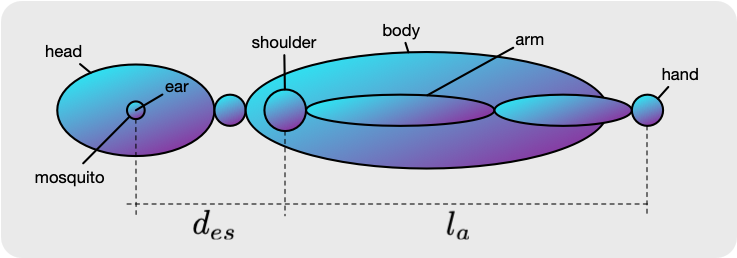
The relevant variables are:
- $v_m$ — speed of the mosquito,
- $v_a$ — speed of your arm,
- $l_a$ — length of your arm,
- $d_{es}$ — distance from ear to shoulder.
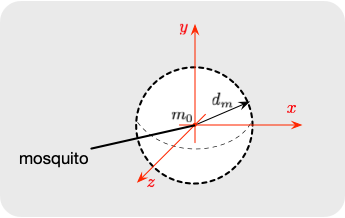
We place the mosquito exactly at your ear. The moment you decide to swat, it starts flying away in a random direction. After $\nabla t$ seconds your hand reaches the ear position — but the mosquito has already moved to some point on a half-sphere of radius $d_m$.
Derivation
The radius of the escape half-sphere is how far the mosquito can travel in the reaction time $\nabla t$:
The reaction time is how long your arm takes to reach your ear from rest, travelling distance $d_{es} + l_a$:
Assuming the mosquito is uniformly distributed over the half-sphere, the probability of catching it inside a ball of radius $h$ (your closed fist) is:
Numbers
- $v_m = 0.56 \pm 0.1 \ \left[\frac{m}{s}\right]$ — average mosquito speed,
- $v_a = 2.5 \ \left[\frac{m}{s}\right]$ — arm speed of a young adult [1],
- $l_a = 0.6 \ [m]$ — average arm length,
- $d_{es} = 0.2 \ [m]$ — ear-to-shoulder distance,
- $h = 0.04 \ [m]$ — radius of a closed fist.
Plugging in:
The mosquito will probably fly away :)